
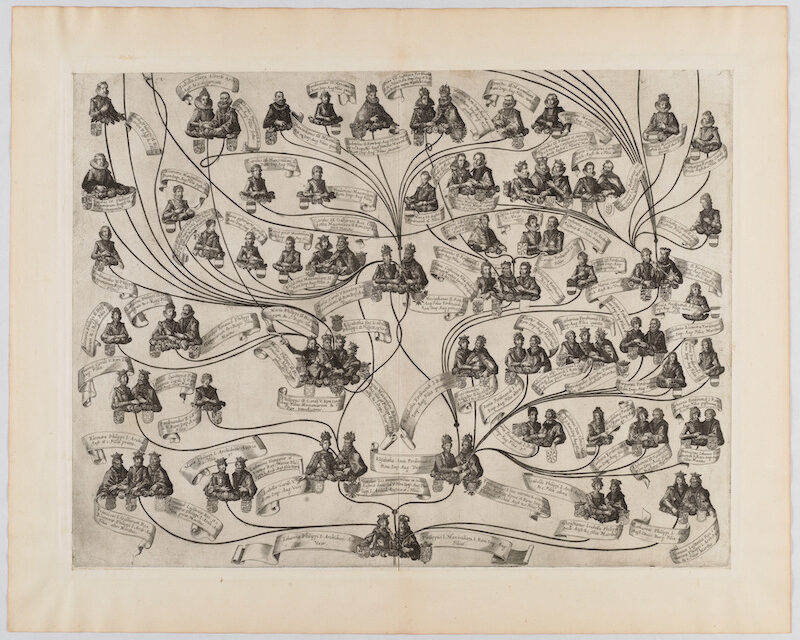
Sadeler, Aegidius I. Family Tree of the House of Habsburg. Metropolitan Museum of Art
Sister Mary Elephant Explains Epigenetics to the Eight Grade Class of St. Sebastian’s Elementary School
by
Jan Thompson
November 1963, Pittsburgh, Pennsylvania
“Listen up!” said Sister Mary Alphonse, standing at the front of the classroom and whacking her rubber-tipped pointer against the chalkboard. We listened. When she had her wits about her, she was a relentless hunter-down of slackers, jokers, and lavatory smokers. But she was starting to slip, and you never knew what might happen. It might be a pop quiz. It might be the Venus of Willendorf slideshow. It might be anything.
“Listen up! You’re thirteen years old. All you dream about is fame, fortune, fun, and movie stars. But one day the scales will fall from your eyes. You’ll realize that the world is a carnival of donkeys, and some of you will wither like delicate flowers at the injustice of it all. Some of you will whine and blame other people, and say it’s all bad luck. You’ll go home every night from your low-paying jobs flipping burgers and you’ll flop on the couch, open some beers, and watch wrestling matches on the television. You’ll smoke like hoodlums. Some of you are headed in that direction already, I see. You’re the ones who’ve already stopped listening. Go back to rolling your spitballs. I’m speaking to the ones here who have brains attached to their ears.”
She pointed at me.
“Miss Gibeau,” her voice dropped. For a second, she was uncertain, wavering, almost human. “Remember. The sufferings you endure will change you forever, for better and for worse. You’ll pass these changes along to your children, and some of these changes will pass to your grandchildren, and your great-grandchildren.”
* * *
How did Sister know about epigenetics? Freud had instincts about human psychology long before they were confirmed by science. Sister had the same instincts.
* * *
In July, 1962, our father was sent by the Air Force to study engineering at the University of Pittsburgh. As were most places we moved to over the years, Pittsburgh was an alien land. The houses ran along jagged hills and the steel mills pumped yellow gas into air that tasted like sulfur. The neighbors were Italian and told Polock jokes and hated the blacks whose houses were creeping down the hills toward them. Although he was never more than an ambivalent Catholic, our father enrolled us at St Sebastian’s, the local parish grammar school. The school was headed by Father Cardozo, the parish priest. He was the antithesis of Christianity, at least according to the tenets our Protestant mother had taught us. If he’d ever learned it, he’d forgotten about Corinthians 13:13: So now faith, hope, and love abide, these three; but the greatest of these is love.
Maybe he resented the fact that there were five of us foisted upon his school, using up the meager resources intended for the lower-middle-class kids of the parish. He had a point. We rarely attended Sunday mass and therefore contributed little to the collection basket. Father Cardozo had a plan to expose us, the five freeloading Gibeaus. He told all the pupils to write essays on Monday morning on the subject of the previous day’s sermon. I figured out that the sermons were all based on the church calendar and were written up in the missal. So I wrote my essays based on the missal and foiled Father Cardozo. He still glowered at us, including my five-year-old sister, but he never came up with his next move.
Our parents were oblivious to this. They had their own problems. Our father was desperate. Nobody in his family had ever earned a degree. He was all alone, stuck on a tree limb with a storm howling around him. He was still the poor French-Canadian kid in a town where being poor and French-Canadian made you stupid, and he never outgrew this. His father was a janitor; his grandfather had been an illiterate paper mill worker who ran booze and cigarettes across the Canadian border during Prohibition. His family never overcame those prejudices, nor were they able to get ahead while others did. Our father fought to escape. He got three steps ahead, but that was it.
I wondered why. I studied his brothers, my uncles. Now and then, back in the 1960s they’d gather around their mother’s kitchen table, drinking beer, playing poker, and eating Michigan hotdogs with sweet chili. And they smoked. They smoked so much you could hardly see across the room. They laughed and laughed and they all had different laughs. They boomed, and chortled, and one laughed in silence until tears ran down his cheeks. We kids avoided the kitchen while the boisterous poker playing went on. The only bathroom in the house was located in the kitchen, right across from the table, and the uncles would stop whatever they were doing and laugh when we tried to sneak past them. Sometimes we’d go outside and pee in the bushes rather than face down the ridiculing of the uncles.
Meanwhile, their mother was trying to sleep. She worked as a lunch lady in the high school and had to get up early. Her bedroom was separated from the kitchen by a chintz curtain pulled across the door.
Like everyone on that side of the family, she was always of two minds: she was resentful and she was proud. The Gibeau boys were better looking than the Kennedys, she said. She kept a photo of JFK on the living room wall, with a Palm Sunday frond tucked behind it. Her son Joe hated JFK. I loved my uncle Joe before that. It was my first realization that there was a mean crazy streak among the Gibeaus.
When the Gibeau boys met obstacles, they used cunning and slipperiness to escape. One of them, Uncle Charlie, went across the border into Canada, where he rented storefronts, opened up exercise centers, equipped them with machines, and sold lifetime memberships to the local women. Then, a few weeks later, he’d pack his equipment into a truck in the middle of the night, abscond to another town at a safe distance from the preceding, and defraud a new batch of women. Finally, the police caught on, but Uncle Charlie escaped from Canada with the Mounties on his tail. Another time, he stole a load of cocaine from a Mexican gang and flew it across the border in a small plane. He waved to the gang as they shot at him with pistols. He told these stories to his brothers and his mother, and he howled with laughter. It was his glimmer of genius.
My father had some of his brothers’ traits. He also had positive ones: he was smart, and he could instantly make the right decision and act on it. Once he jumped into a swimming pool fully-clothed when he saw my four-year old son floundering in the water. I didn’t realize what happened until Erik was sitting on the edge of the pool, gasping and confused. He made other instantaneous decisions, and they showed him at his best. Maybe it was the genetic load bequeathed to him by his mother’s side.
In January, 1952, my father was flying a photo reconnaissance mission over North Korea when his plane was hit by anti-aircraft fire. His cockpit was jammed and he couldn’t parachute out, so he crash-landed into a frozen rice paddy. He broke his back and suffered a concussion, and a mob of angry farmers dragged him from the cockpit. They told him to give them his wedding ring and he refused until they mimed cutting off his finger. One of them stripped him of his wool-lined leather jacket, found his pistol and raised it to his temple. A Red Chinese officer ran toward them shooting his pistol in the air. The farmers no doubt resented this imperious stranger, but they released their prisoner. Our father’s life was saved by the enemy. He spent the next year and a half in a Red Chinese POW camp where he was tortured, starved, and kept in solitary confinement. The Chinese accused him of dropping bombs on North Korea infected with lethal germs to infect the populace with disease. He and a band of other pilots called themselves the Obane 13, and they refused to confess to their enemies. My father was forced to make one quick decision after another, and he made brave decisions.
In September, 1953, he was loaded onto the last truck of POWs to cross the Bridge at Panmunjom. He weighed ninety pounds, he was almost blind from malnutrition, his black hair had turned white, but he was free. Unfortunately, this proved to be the best moment of his life.
Soon after he came back to the States, the archangels descended bearing gifts. Some were golden eggs; some were rotten. Some were the effects of his experience. Some were gifted from millions of generations of evolution. One gift was an intractable contrariness, which made us reject dogmatic statements of every kind. Another was a vulnerability to the sufferings of others. Jung once said that cruelty was the dark side of sentimentality. Then there was the mixed bag of psychological illnesses our father carried in his DNA: anxiety, depression, schizophrenia. He also gifted us with his experiences and the character traits that enabled him to escape: calm bravery that carried him through the worst, but only in the moment the worst happened. When life itself was calm, he often faced it with a wishy-washy attitude. We also had the traumatic experiences our father inflicted on us. These were in part a result of his PTSD; others were embedded in his DNA. Some of us rose above these gifts, some of us drowned, and some barely escaped.
At first, I didn’t feel the immediate effects of these gifts. Neither did my oldest brother or my younger sister. We were all born before our father went to Korea. We’d spent that time living with my mother’s family. What affection and coddling we received there. The six children born after us inherited our father’s freshly mutated DNA. The first one born after his return, my middle brother, was born a year after our father came home. He said his genes were shot out of the sky and crash-landed into a frozen rice paddy.
When he came home, our father received months of medical care, but no psychological treatment. In those days, battle fatigue was unmanly. Cowards cracked up. Heroes were stoic. He never asked for help, but he was terrified. He had nightmares about being buried seven feet deep in a hostile land. He heard men walking above him and he screamed, “I’m an American! I’m an American!” But they didn’t hear him. He returned to work and family life, and he was a bomb with a fast-burning fuse. It burned until the day he died, sixty-seven years later.
Another aspect of our father came from left field. Maybe it was attached to a stray genetic offshoot. During his time at the university, he wrote formulas on the inside of his ties so he could cheat on tests. They were written in ink. I saw them, and they made a big impression on me. This was in 1963. In 1985, when I was attending law school, I remembered this. It set me out on the limb of a tree that cracked in a howling storm. I feared these conniving genes almost more than I feared the other traits he carried.
I was afraid of a lot more.
Studies have looked at the lives of families headed by fathers with PTSD. The facts might differ from family to family, but the basic horrors repeat. Captivity, torture, and starvation change a person. It doesn’t kill love, but it suspends it over a black pit.
I used to have nightmares about being devoured by a monster. At the last minute, a light-bearing being always snatched me from its jaws.
* * *
Sister Mary Alphonse was onto something. Evolution happens faster than Darwin could have imagined. Stress changes us profoundly and immediately. Some of these changes are passed down to our descendants.
Years after she died, I became interested in genealogy. I should say, I became obsessed with genealogy, and I searched for those traits I shared with my close DNA matches. Where did my paternal grandmother’s family come from? What traits did she carry and pass on to her brilliant and ravenous pack of sons? She’d been a lowly lunch lady, poor and insignificant. But she was tough, and smart, and she was my father’s mother. Where did his bravery come from, his inexplicable tastes for fine things, and his intelligence? The website that sold the DNA tests posted the family trees of the individuals who matched our DNA. This was voluntary, the consent given both by the curious and the lost. Based on the DNA tests done by her nieces and nephews, I found Sister Mary’s name as a close match to ours. It jolted me like lightning. It shocked me that we had somehow gravitated to the same place. She had taught me and singled me out. She had shown me her intelligence, her obsession with history, her tendency to develop cognitive decline that never overcame her intelligence. I had hit the motherlode, and I treasured it like grace from heaven.
I had always thought my grandmother was 100% French-Canadian. I’d known she was an orphan who never knew the names of her birth parents. Now I found out that her family name was Lucey, and her family had landed in Boston from Ireland. Was my grandmother illegitimate? Was she born in Boston? Did her mother give her up for adoption? In those days, the early 1900s, that was likely. Or did her mother have too many children and no money? Is that why she gave her away? Abandoning a child is an escape from one form of desperation into another. Whatever happened, it was desperate.
Sister Mary Alphonse, born Maureen Lucey, joined a teaching order of nuns in Boston, and from there was assigned to Pittsburgh. From the family trees of my Irish relatives I discovered that the Luceys emigrated to America from Skibbereen, the southern tip of Ireland that suffered from the potato famine of the 1840s. I looked through the names of the Luceys and tried to trace where they went, hoping to find my grandmother’s mother. But the Lucey women were poor, illiterate, and worked menial jobs. They sank and disappeared. Sometimes they even evaded the census takers, but they most definitely left their Irish genes behind.
Sister Mary Alphonse had a baby sister, Rose, who wrote a short family history of the Luceys in the 1970s, and her great-niece posted it to the web in 2004. I looked for family traits I’d recognize among my grandmother, my father, and my siblings.
Epigenetics studies the effects of profound stress upon the genes. Some of the genetic changes produced by stress are inherited by descendants. One study looked at the grandsons of men who had experienced starvation. The grandsons inherited a tendency to retain fat, and had trouble losing weight despite all efforts to diet and exercise.
Evolution doesn’t always produce a spot-on answer to the source of a particular type of stress. Sometimes it goes one step at a time. For example, our father, the reconnaissance pilot, had an excellent sense of direction. A majority of his children have none at all. If the correct direction is right, we almost always turn left. Not 50% of the time, but 90% of the time. That might be because my father’s sense of direction wasn’t always carrying him where he needed to be. Or maybe it came from our mother. Wherever it came from, the trait is evolving in other directions among our parents’ descendants. A few weeks ago, my middle brother made an inflammatory comment about the politics of liberals, and our nephew came back at him, not by getting huffy or arguing, but by taking his words even further: Yeah, let’s send them all to Guantanamo Bay and waterboard the hell out of them. Our brother stopped in his tracks. Which way do I turn now?
* * *
January 30, 1849, Skibbereen, County Cork, Ireland
That day the bailiffs came to the farm occupied by Cornelius Lucey and pounded on the door with their batons. Cornelius knew what was coming. His wife Maureen lay on the bed coughing and baby Johnny lay at her side. They were skinny from starvation. Maureen was dying from consumption. Cornelius was a hard worker, but hard work doesn’t pay the rent when you live off your potatoes and the blight kills your crop. Every fall the potatoes he dug up were black, rotten, and smelled like death. He secretly blamed his wife, because her infectious breath probably withered the plants. He didn’t keep his secret well, because he beat Maureen when the rage came over him.
The Luceys sold their pigs and their milk cow, and their clothes, and Maureen’s few pieces of family silver, and their furniture, and then they had nothing left to sell, and nothing to eat, except for what the parish provided. Charity dwindled as the blight spread. Some of the Protestant churches helped too. Then all charitable resources were depleted, and Queen Victoria donated a nice bit of cash, but the British government did nothing. They waited for the Irish to die off or emigrate and spare them the trouble.
The bailiffs handed Cornelius a piece of paper. He couldn’t read, so the head bailiff read it for him. “Cornelius Lucey, we hereby seize this property on behalf of Lord Abergavenny, the owner, for nonpayment of rent. You are ordered to remove yourself and all of your possessions from this house, and leave forthwith.”
The bailiffs removed the Lucey’s possessions from the shanty and piled them in the yard. They hammered planks across the doors and windows. They picked up Maureen on her mattress and laid her on the lawn. Johnny lay beside her, wrapped in her shawl. It was then that Cornelius picked up the hoe and swung it at them. “Luceys have lived on this property for four hundred years, one hundred years before your lord took it over.” He raised the hoe over his head and the bailiffs ran away, except for the head bailiff, who didn’t budge. He hit Cornelius across the head with his baton, knocking him flat. “Clear off, scum,” he said. “If ever you darken the doorstep again, I will take you by the seat of your pants and toss you into gaol, and your woman, too.”
At that moment Maureen raised herself up from the pallet, and spoke with an eloquence no one had heard before. “Do you call yourself Christians? Is that what your Protestant religion teaches you? I think not, for your God is a Christian God. He will condemn you for the sins you are committing in His name and the name of the English oppressors. Your children will bear the weight of your sins, and they will creep around on the earth like rats for seven generations.” A glimmer of genius. Then she fell back and died. Wiping the blood from his face, Cornelius tucked baby Johnny into the front of his coat. Johnny’s eyes opened wide, but he remained silent; he didn’t talk until he was five. Cornelius’s sister Kathleen told him to leave Johnny with her, and he was tempted to do it, but he knew what his family would think if he did. Instead, he took Johnny along with him, tucked into his coat, and he went from door to door pleading with relatives and friends and the parish priest until he scraped up enough money to buy a steerage ticket. After four weeks of storms, death, and scanty fare, he and Johnny docked at Boston Harbor. Cornelius intended to return to Ireland a wealthy man and buy his farm back. But no fortune awaited him in America. He had left Ireland forever, and spent the rest of his life as a laborer, digging ditches and mucking out horse stables.
In 1880, Cornelius’s granddaughter, little Maureen, was born to Johnny and his wife Eileen. She was the tenth of thirteen children. They lived in Boston, in the Cork Irish part of town. Her father Johnny was a hard worker, but he also drank and beat his wife and children. Johnny died at the age of fifty-two, leaving Eileen to raise the children by herself. It was a relief. Fortunately, the oldest children were working, so they ate and had a roof over their heads.
Little Maureen attended grammar school until she was twelve, then she quit school and worked in a cotton mill. She gave her mother half her wages and saved a dowry for herself. She held herself separate. Never wanting to marry, she used her dowry to join the Order of Ursulines at the age of eighteen. It was an escape into one of the only respectable professions available to women of her religion at the time. That’s what she told herself, anyway. She moved five steps further away from her family. She became Sister Mary Alphonse, obtained a teaching certificate, and taught in parochial schools for sixty years.
* * *
We called her Sister Mary Elephant from the joke, “What’s fat and has a good memory and stomps on you when you sin?” Sister found out about it, and shocked us with her reaction. At the beginning of every semester she wrote on the blackboard in yellow chalk: Sister Mary Elephant, Science and Catechism. She was by then developing cognitive problems, and she was also exhibiting a new and exuberant sense of freedom. She abandoned her teaching duties and apparently along with it, she cut ties with her faith. The slide-shows about ancient art became a daily occurrence. None of us complained. We were deathly afraid of the school principal, Sister Hildegarde Bernadette, but the end was inevitable. Some sniveling brat complained to their parents, and one day Sister Hildegarde Bernadette stalked into class while Sister Mary Elephant was doing one of her slideshows. Sister Hildegarde Bernadette was as ferocious as Sister Mary Elephant had been in her prime. She raked us with the eyes of a hawk descending on a rabbit.
The slide on the screen was a full frontal of the Venus of Willendorf. The Venus has no face or arms or feet. She is nothing but enormous breasts and vulva, the creation of some ancient ancestor obsessed with the female body and its mysterious fecundity.
“This is catechism class, Sister, and this is both obscene and ungodly …” said Sister Hildegarde, clicking the rosary beads she wore around her waist, “… and I will relieve you of … this.” She ripped the slide carousel off the machine, careful not to damage the projector as it was school property. “Children, you will all go to confession, and you will forget everything you have seen here.”
“Mary the Mother of God had the same equipment, Sister,” said Sister Mary Elephant, grabbing the carousel out of her hands, “…and so do I. And so does every girl in this class. And so do you, Sister, and I believe you want every girl and every boy in this class to forget all about it, and that is both obscene and ungodly.” It was the ghost of her namesake from Cork, her namesake and grandmother, Maureen Lucey.
A week later, Sister Mary Elephant was taken to the convent for old nuns. We heard that the nuns kept her from escaping by taking away her clothes, and a doctor prescribed sedatives to keep her quiet.
* * *
Here’s an old snapshot of my baby brother, sitting on the front lawn of our house in Pittsburgh. He’s playing with a red truck while Josephine Bone-Nipper, his basset hound puppy, ambles by herself toward the camera. Josephine was the dog our father would beat in the front hall when she peed on the floor. We all heard it. We lay in our beds listening to the yelps and thuds and cursing. Despair sank in, then relief, then hope. That’s what the avalanche of happenstance taught us. My brother’s genes fell from the sky, but the oldest of us learned it from experience:
“Pretend it isn’t happening. You know it will be over soon. Maybe there’ll be a miracle.”
My brother’s only child had nothing to hold her up. She fell and fell, and died of a drug overdose nine years ago. She left a five-year old child whose growth immediately twisted in another direction. I may not live to see how her children turn out.
* * *
How did Sister Mary Elephant become obsessed with ancient art and the Venus of Willendorf? Maybe it had something to do with her mother’s unfortunate fertility, or the bad luck of her ancestors. More likely, it was evolution moving in an unexpected direction, a gift from the universe. It came late, but it came.
* * *
Many years after Sister died, Gemma Coppola, one of the girls in my class, crocheted an elephant out of grey yarn and laid it on Sister’s grave. She was one of the kids who didn’t listen to Sister’s warnings. She went through all the stages: despair, low paying jobs, fentanyl instead of beer, porn movies instead of wrestling matches. Then she turned it around, went to community college and got a decent job. She had a daughter who went to medical school and was obsessed with ancient art.
* * *
How they made their ends:
- Grandma was out in California staying with her sons, moving from house to house as she drove one daughter-in-law after another “up the wall,” as Aunt Mitzi said. She had six daughters-in-law, but she ran through them fast. At the end, she put herself on a plane and flew back to her apartment in New York because she didn’t trust her sons to bury her next to her husband. Two days after she got back to Plattsburgh, she ended up in the hospital. One day later, right before she died, she looked up into the corner of the room and her face grew radiant. She saw someone, but who?
- Sister Mary Elephant called her sister Rose on the phone about a week after she was forced into retirement. Rose, who cried when her sister joined the convent, was the first in the family to attend college, and she became a social worker. She hustled down the dirty streets of Boston and Pittsburgh, offering practical aid to the poor. If there was a Paradise, she’d never seen it, but that didn’t mean people had to lead miserable lives.
Rose pulled up to the convent in a pink and white Plymouth station wagon with tail fins. A tiny old nun led Rose to Sister’s room. Rose puffed on her cigarette and took it all in. Sister Mary lay in her bed wearing a white nightgown with a cap tied under her chin. Her fists were clenched and she glared at the tiny nun standing guard in the doorway. On the nightstand stood a bottle of phenobarbital and a glass of water.
What followed was a stand-off between Rose, the little nun, and Sister Hildegarde Bernadette. Rose was ferocious, and she knew the system. She accused them of kidnapping and drugging Sister Mary. She said that the bishop wouldn’t appreciate bad publicity at the moment, because other dead fish were stinking up his closet. Sister Mary Elephant clinched it by putting on her coat, her shoes and tucking her carousel of Venus of Willendorf slides under her arm. “See, Sisters. I take nothing with me that isn’t mine,” she said.
Sister Mary didn’t have Social Security because she’d never been paid a salary, but Rose took her in. She set up a cot in the living room and dressed Sister in her slacks and blouses. On the first night, they ate pizza and Boston cream pie, played pinochle and drank a high ball. Sister, who hadn’t laughed in a long time, laughed until she cried. Then they watched The Egyptian. When it was over, Sister said, “That movie is historically inaccurate.” Rose replied, “Maybe so, but it’s one of my guilty pleasures.” After that, Sister lay silent in her cot. A few nights later, she sat up in her cot with a radiant look on her face. “It’s her!” she said, and fell back dead.
- At the age of ninety-three, our father fell and hit his head on the edge of a table. In the hospital, despite a lifetime of discord, all six of his daughters gathered around his bed. We told stories, laughed, cried, joked and sang songs. We had always known he didn’t want to die alone.
Right before he died, math problems streamed in front of his eyes, and he told our mother to move out of the way so he could solve them.
- I earned one degree after another, but never found a job I felt was right. I was a misfit, and my life was in turmoil. My husband had a good paying job, so I retreated to my room and read books about medieval history, watched the same movies over and over again, and constructed family trees. I started to watch YouTube videos about people who build caves out of rock and live in solitude. I preferred the caves with fireplaces where you can boil water for tea and bake bread.
A year ago, a psychiatrist diagnosed me with bipolar II, ADHD and neurodivergence. I was relieved to have a diagnosis. She prescribed lamotrigine and Ritalin. At this point, I couldn’t expect radical changes, but for the first time, I had an organized life. I made my bed every day; I paid my bills on time; I faced most problems as they arose. The pit was still there, but I could climb out of it.
Looking at my father, my siblings, and my children, my granddaughter, my nieces and nephews, and my great-nieces and nephews, I see neurodivergence everywhere. Experience and evolution have pushed us to the very edge. Maybe it was the generations of us who left the farms and worked on assembly lines doing repetitive drudgery. We hated the monotony, but we also developed the ability to withstand long hours performing boring tasks. When we became educated, we had more choices. We developed interests we preferred to drudgery, and we focused our improved attention spans onto those interests. When we had to perform tasks assigned by other people, we couldn’t put our minds to them. We jumped back and forth between duty and passion. If we were lucky, our jobs were our passion, but that didn’t always happen.
We quickly passed along this bundle of traits to our descendants: attention deficit disorders, interests that become passions, and anxiety attached to every duty. Indulging in our all-consuming passions isolates us, taking up all of our time and attention.
When we educate ourselves and get good jobs, it’s easy to escape from family misery. Unfortunately, unhappy family life doesn’t prepare you to form bonds with others. Nor does neurodivergence, which makes you into a new variant of the species. It makes you awkward, you push people away, and you’re happiest alone, but not very happy.
So, who will visit the neurodivergent at the end? Maybe someday we’ll be self-sufficient, and we won’t care.
By the way, both Sister Mary Elephant and her sister Rose were close enough genetically to be either my great-grandmother or my great-great aunt, although it might have been one of their sisters who was my grandmother’s mother. My grandmother was born in 1904, when most of the Lucey girls were still fertile. I’ll probably never know which sister was my grandmother. I’ve searched for years, and have reached a dead end.
Jan Thompson grew up an Air Force brat, moving from place to place every three years. She was first impressed with the beauty and mystery of writing when she discovered the medieval manuscripts of Laon cathedral in France. After earning a degree in English from U of Iowa, she made a detour into law school, where she learned how to write a piece from beginning to middle to end. Eventually she earned an MFA in fiction writing, and since then she’s written short stories published in a number of journals. Maybe someday she’ll finish one of the novels she’s begun.
