
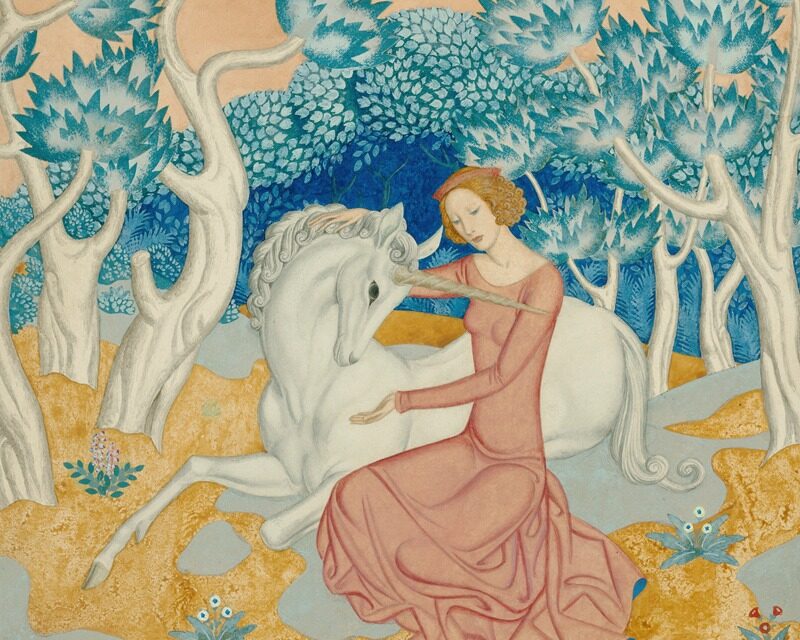
Dulac, Edmund. The Maid and the Unicorn. Private collection
See the Unicorn
by Thea Swanson
My mother, shrunken and bent and three thousand miles away, falls on Buffalo ice near her crumbling house. Strangers carry her tiny frame, holed by osteoporosis and seahorse-light, across her threshold and place her on torn linoleum, like a piece of coral.
*
A white unicorn prances on my desk. She is twelve inches long and twelve inches high, and when her discrete button is pressed, holographic glitter rolls through clear fluid from withers to flank.
*
My mother would buy me gifts from the dollar store. These were the days she could easily browse, before the days of stuffing newspaper in the crown of her hat to give her little skull some heft.
*
A light pulses from her muscular yet elegant neck in tandem with the waves. She was mass-produced in China, this I knew before turning her over to check. She is plastic from horn to hoof, and I grieve her imminent passing, when the bulb within dims, when the motor, affixed to her opaque chest muscles, ceases.
*
When an eighteen-year-old girl in the 80s, I married a twenty-year-old boy in City Hall for a year. We had been a secret. He disappointed me with bruises and lies, but once I walked into our apartment to the sight of two miniature crystal swans floating on the mantel. They faced each other, their gazes directing mine to a tiny diamond set in a belated gold band, which, in time, I whipped across the room along with the swans whose wings sighed before hitting the floor, though perhaps the sound was mine at the sight of his tear.
*
I possess a one-inch pewter plaque hammered in this way: It takes a long time to grow into the person you’re meant to be. This gift from my mother I refrained from tossing, but not without derision: No one is meant to be anything.
*
Three months ago, I flew from Seattle to Buffalo to visit my mother, my father-in-law, and my friend: three pieces of my life that I pick up and hold and put down again for years at a time until they are no more.
*
One year ago, my mother-in-law died. Bins and drawers vomited strands and strands of peach and purple coral, sand-dollar sized designer brooches, cream-white leather bags, containing original fifty-year-old tissue paper and price tags from L.L. Berger. These items were not hers but her mother’s. My mother-in-law once thought to be a nun. My grandmother-in-law decided to be glamorous, and was an addict. A dark dragon first small: a chenille sweater basking over a chair against a wall. Then it throated out, imbricating into the center of the dining room–its overlapping substances: tagged blouses, silk and rayon, heavy leather coats and skirts, chiffon scarves in twos and threes, high-heeled boots in boxes. The family murdered the dragon when her husband died. But jewelry is easy to tuck. I spread all that would fit across my father-in-law’s table: Behold.
*
When you are a renegade swan-shattering girl-bride, you try to make amends. Not to the swan-buyer so much as to the mother who isn’t talking to you, who scares you, who you heard had stalked you, who had swung at you, who had been drinking and pulled off your blanket and pinned you with forearms and devil words so that you roared GET OFF ME and broke free and ran downstairs to the neighbors who had woken, and there you stood, shaking in your nightshirt. But that was eons before you shattered swans (three years), and you find your skinny young self taking a bus downtown with eighteen dollars and searching all a-frantic, eyes wide, here and here, shelf and store, for a gift because it is June, and her birthday is nigh, and your eyes alight on a petite porcelain clown of which you can afford, its face eggshell white, its pants jaunty puffs, and you take him home in the rain and write a tiny note on the affixed tag: One day, I will be rich and make you proud. June comes and goes. Clown hides in the closet, trembling.
*
We met at Applebees. I had prepared myself for the sight of her, for the furthering of her disappearance, for the little body, once as tall as mine and much more womanly, to be leaving me and leaving me, for her bosom that had once paid her way as society demanded, to further cave in while the hunch of her spine swelled, an invisible string to an invisible helium balloon carrying her away.
*
My daughter is angry with me. She and I will repeat the cycle. My middle name is my grandmother’s first name. My mother’s middle name is her grandmother’s first name. My daughter’s middle name is her grandmother’s first name. My stubbornness exceeds my mother’s, and my daughter’s heart is undergoing foliation; that is, its properties are aligning perpendicular to pressure; that is, it is undergoing metamorphosis and is turning to rock towards its mother, as did mine.
*
You can have it all for two-thousand, I said to the buyer, waving my arm across the table. My father-in-law stood to the side, gaze low, one hand over the other. The buyer lifted a gold necklace, set it down, a sideways glance to the half-century-old brooch as wide as an orange. You don’t have anything here, he said. I learned the game during the second I traced the taut air between his falsehood and his gaze. Yes, we do have anything here. We have a lot of anything here.
*
But will you be able to eat anything without your bottom teeth? I said. Something soft, she said. She consumed the entirety of a bacon cheeseburger, torn with fingers first. I ate most of a salad dressed with lime. First thing after ordering: I reached across the table, opened my palms, and she placed her fingers inside, as light as ten shadows.
*
A person can stroke a rock. How to lay out her regrets for her appraisal before she has them? Smash them to smithereens? Hug me for real again?
*
At fifteen, I tiptoed into the kitchen, opened my mother’s purse, and plucked a layaway receipt from her wallet. After school, I handed the saleslady at the AM&As jewelry counter the balance remaining on a pair of 14K-gold earrings, two rams butting heads. It was June, and almost her birthday, and my grandmother was visiting, an unusual occurrence, but there she was, on our couch, petting her thirty-seven-year-old daughter’s head on her seventy-seven-year-old lap. Spindly-legged, I entered the room: Would you like your birthday present now? No! She whined, and I stood as two: a child stricken and a wise old woman of many years.
*
The buyer paid for the lot with cash. This we added to the envelope with the check from the boutique antique buyer, a woman betraying nothing, who held each item like a soft wave, who said I was a natural. Do you buy purses? I had left them in the car, bringing the stash through the glass doors two bins at a time. Not so much, she had said. Oh, this one, I yearned. Truly one of a kind. Never used. Still with original tissue paper. The leather like hand-whipped cream.
*
Here is the matter: I am trying to save my daughter from pain.
*
I send my mother hats. In the car after Applebees, she mentioned her tattered hat–or did I notice it? Three thousand miles away, I wrinkle my brow and see her step through Salvation Army with her snappable cannon bones, ankles off-kilter. I drove away from our visit and searched online for extra-small hats with brims, and who knew her hat style is worn by teens in Japan and bears names like newsboy cap and baker boy hat? Even as she fades, she shines.
*
The stakes had been high. One has two weeks to set things straight. One’s mother-in-law, too generous to others, leaves the world and her husband thousands in credit card debt and one less pension check and one less social security check. One learns the art of sales in the glimpse of her father-in-law, a curlicue on the edge of his dead wife’s bed at dawn, chin to chest.
*
No more hats, she says. I have enough hats now.
*
It wasn’t about the money. She needed a large gesture of giving from me that said, you matter just as much as your brothers. I felt this like a hunger. I was clawing, fingers in my gut. I need to send her a check, and it has to be in her hands by her birthday. December fifteenth, so close to X-mas, and there had been three of them, and we had been poor, and she had left at eighteen, and today we have money, and she fathoms (I assume) the boys get chunks of it, chunked out in college tuition or in groceries at home, so I thought–felt (like a hunger)–her rockness would alter its properties somewhat with this gesture. Rocks roll away but sometimes stay close and that is something.
*
But it was so perfect, the first hat-giving. Still in Buffalo, the frayed hat disintegrating in my thoughts, I sat and scrolled on the edge of my dead mother-in-law’s bed and located a small new hat in the Walden Galleria mall, and I headed there next day. On my way, in the rental car, she called. I put her on speaker and spoke: Stay home, ma-ma! I am coming with a surprise! And in the mall of my teens I entered. How grand! The Buffalo mall was better than my Washington mall–no doubt, no doubt. Music and designer facades, lights reflecting off stainless steel and glass, up and down, floors one and two. So perfect for this adventure! Into H&M! The expat with money to spend on her mother! How strange is life, how around things come! I spot the hat, only black, somewhat a disappointment, but no bother; I will look elsewhere for the ivory. I’m visiting, out of state. The salesgirl, still a girl, perks from this information because she is in Buffalo, the city of wishes. I say no more, the mystery keeping these perfect minutes intact. We exchange smiles and small objects. Best wishes, dear girl! I take my most valuable item, the most important item in the world.
*
My father-in-law took the fat envelope of cash and drove it to his credit union and deposited it in person, here. you. go. Back in the house, he sat at the table. Next step: This is what we’re gonna do, I said. I laid out the paper statements. We’re going to pay this one off. The APR is outrageous. He explained: That there was for the surgeries and burial of Charlotte Rose. How to tell these big-hearted workhorses that maybe one shouldn’t bury their beloved black Lab in a pet cemetery with a costly headstone? Maybe not go forward with that surgery on that cancer that is sure to return? Maybe we have to say no to the ones we love, sometimes, because at least one of us has to make it out alive?
*
Ma-ma exits her hovel in her slippers and sweater and enters my big white whale of a car. I can’t go inside and clean for her. I can’t breathe in her air nor open her cupboard to see the same spice jars from years past. I am relegated to restaurants and driveways. But none of this matters because she is next to me, and I place the H&M bag on her lap. She yelps with joy, like she always had done when a small, good thing, came her way.
*
We all met at the Indo-Asian Street Eatery in Tacoma for her birthday dinner, one brother at college, but we felt him. She was soft and happy and glowing and we sat on the same side of the table. She chose a fruity cocktail with an umbrella and leaned in (!) to show me the menu via the QR code on her phone while I rummaged for my glasses. After a perfect and boisterous meal in warm lighting and biggish dessert bowls of black rice pudding and coconut gelato shared, while at our cars, she hugged me tender, her long arms around my shoulder blades, and in my ear she said, Thank you for the generous gift. I told her, thank you. I told her, You needed it.
*
Black Lab Charlotte Rose lived and died as Charlotte Rose because my Buffalo in-laws visited our Washington home in 2010 and our new black-Lab puppy, Roxxanne, lay her head on my father-in-law’s lap, wanting his touch. This act astounded the man, whose previous dog latched onto his giving hand with teeth that tore flesh. Two days ago, Roxxanne’s stubborn, old, long legs held fast to our living-room floor as the pre-euthanasia sedative swam through her bloodstream, her eyes detecting the trick: What’s this? I thought you were holding me because you loved me?
*
The hat fits! XS. Earrings and lipstick will tie it together. And do you need a new coat? We had been in Rite Aid after Applebees because she had mentioned memory pills. I bought scores. No! She yelled. It’s too much. No ma-ma. It isn’t enough. This is for both of us. Please don’t leave me. In the car in her driveway, in her slippers and sweater, she remembers old times: Yes, it’s true. I did do that. But it’s because I was afraid I would lose you. I nod all grievances away. Her heart is in her eyes, and when you’ve communed with those whose hearts rest mostly in their reflection, and when you see her disappearing at the same moment you want her most of all, what is a mother’s infraction of a hundred years ago? When you both will be at some point, at best, fond memories, or at worst, a scratching of a head?
*
A cancerous nose tumor we let grow to the size of a softball sealed Roxxanne’s eye and nostril. She had been doing something new: spreading like a seal on the cool tile near the door, legs like flippers on either side, neck flat, a sigh going down. She had been sneezing, snorting, oozing mucus from her mouth, coughing it down. She had been dropping her canned-chicken-covered codeine pill on the floor from her mouth. She had not heard me call her name, only two feet away, only one foot away, only inches away, had startled at my touch. But strong senior she-dog! You trudged off the deck to relieve yourself! Until the last forty-eight hours, you found your way in the dark down the second-floor stairs, nose mountain be damned! And Lab to the core, to the heart and to the soul, you returned to your food dish, returned to the treat, to the new morsels offered since the prognosis: Here is a holiday Swedish meatball, a potato pierogi, a noodle, my love. All for you, people food, finally and only now, now that my thirteen years of rote dedication to the scoopful of pellets and the teeth-cleaning biscuits did not stave off the worst. I tried, my sweet girl, but alas, eating correctly and walking regularly were but actions in a play, our lines we knew, performed daily, but it was all a smoke screen, and I was a fool, for keeping you from your most-wished-for things in the whole-wide-world, cakes and steaks, things you never ever got to taste, not even a crumb, did not make your quiet life better, after all. How is it that I measured your life’s worth with the same criteria as my own (though even I, hypocrite, got to eat delights)? And why did I have to learn this as you licked nutmeg sauce from my fingers with a glassy eye, the day before your death, that even as you could not hear me, even as your face skin stretched to contain an infiltrated enemy within, even then you simply wanted to taste something good? And even on the day of your scheduled death, when you perked, stepping pony-like from family member to family member–yes, we were all there for your special day, all gathered on the floor to see you off–even on this day when daughter arrived and headed to your treat box, even then I said, No, don’t give her a treat. I then shook my head, shook my words away, No, give it to her; what am I saying.
*
Ma-ma lets her dogs lick ice cream from her cone. Her first dog lived to eighteen years, her second to fifteen. Her third hops on her lap, gazes at her, and pushes her snout into Ma-ma’s plastic water tumbler, offered with patience as she gulps.
*
I had proclaimed the words again and again. I was unsure if you could hear but spoke over your body on the floor, into the ear opposite the evil mass, son’s hand underneath your neck: Good girl! Good girl! Good girl! I had choked out the words, forced them. After you were carried down the porch steps on a stretcher with a fleece doggie blanket, tucking you in, I slumped in a chair and said, I didn’t want her to feel any fear as she faded away. Daughter stood over me, resting her head on my crying one. Against my skull, I could feel her throat tighten, keeping sobs from flooding.
*
I have something for you in the car. Ma-ma said, and wiped her translucent fingers with a napkin. I paid the check, a meager, ridiculous and singular face-to-face act during these past eight years of separation. In the Applebee’s strip-mall parking lot, as the September sky wasn’t blue or gray or any color at all, as the temperature was nondescript and forgetful, my mother’s second-hand jacket hung from her bowed torso as she withdrew, from the backseat of her car, a large and sparkly pink-and-white bag, massive swirls and stars stretching off its edges, tissue paper reaching out to the air, and she plunged her hand inside and gripped the unicorn with care and purpose, and she held it up high for me to see.
