
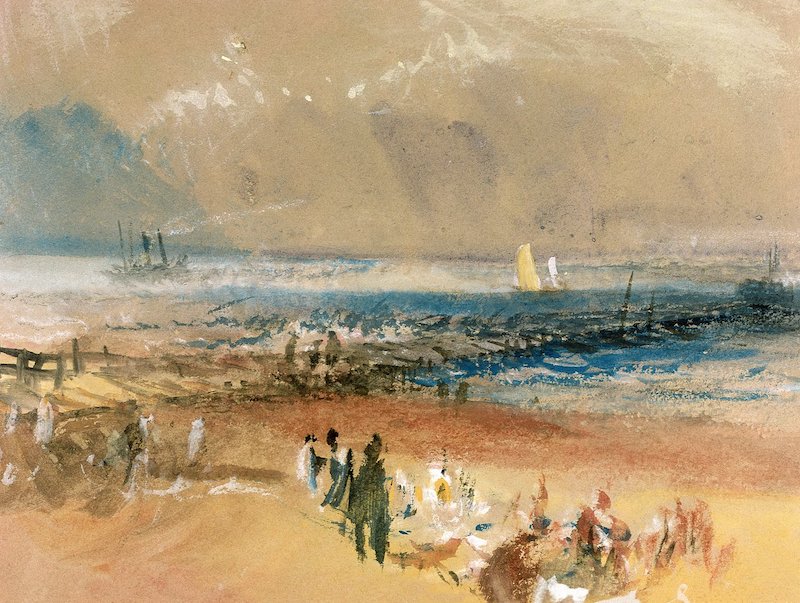
Turner, Joseph Mallord William. Boats at Margate Pier. The Courtauld Gallery.
On Margate Sands
by Stephen Orr
1. The Burial of the Dead
Ben White started his second day at Margate with a self-guided tour. From his hotel, down the hill to the beach. Luckily, it was still school term, so there wouldn’t be many kids, because if there was one thing a recently-retired teacher didn’t want, it was kids. Following the map, he explored the back streets, the lanes, the awkward mix of Victorian and failed sixties architecture, most notably the 18-storey Arlington House, with its grimy windows and grey cladding. He read: ‘When it was opened in 1963, Arlington House promised affordable accommodation for holiday makers, as well as something modern and vibrant for locals’. Beach or no beach it was … anyway, let’s be positive, he thought, walking into the Margate Caves, wondering if Eliot had been here, too, the touched-up murals, the dry well full of chip packets. Back up and outside to Joyce’s snot-green sea (smiling as he remembered telling his students about salt air and scrotums), Cain’s amusement arcade, three attempts at picking up a pink dinosaur before he decided it was time for lunch. Fish and chips, crunchy, steaming, and a conversation with a Brazilian backpacker about seagulls. He was glad, in a way, Eliot hadn’t come here (or had he?). Surely Cain’s would’ve made it into The Waste Land?
Out along the beach, the angry Atlantic, and he guessed Eliot saw this, too, chose not to represent it as a metaphor. That would’ve been bad poetry; that would’ve been lazy. The scummy harbour, the mix of water and oil and more chip packets, rotting sewerage-smelling seaweed, Death by Water. Past the clocktower to the shelter. He sat on the same hard seat as yesterday. He wondered why. Habit. He was a creature of habit. He had been for too long, and perhaps that was part of the problem, or the problem itself, but either way it was what’d led him to the Nayland Rock Shelter in front of the Nayland Rock Hotel. He thought, Where? Where had Eliot sat? Here? A few along?
He’d searched when he’d arrived the previous day, hoping to find a blue plaque, some sort of panel, anything – but nothing, nothing at all about where (arguably, he’d had this discussion with his Lit classes for the last twenty-eight years) the twentieth century’s greatest poet had sat staring out to sea, same hard seats, same uncomfortable arm rests, same tessellated tiles, same beach, same wet, wind-worn Union Jacks slapping themselves silly in a southerly gale. He felt he had to know. Otherwise (in a sense) what was the point of coming all the way from Australia? What was the point of his Waste Land pilgrimage? So he’d asked a dozen, maybe more, people since his arrival, but no one had known. A few had known about T.S. Eliot (‘Oh, the fella and the cats?’), but nothing beyond that. No Prufrock or cruel April or Vivian or Val or any of the hundreds of things he’d read in the poetry, the letters, biographies, all of it, nothing. How could this be? He’d come to believe that British people valued their culture. He’d come to believe that Australians didn’t give a rat’s about theirs. So wouldn’t someone (especially those who lived here) know something? So he’d made it his goal – find a visitor centre, library, something, someone who’d tell him exactly which seat Eliot had sat on while he was writing his poem (though it was likely, assuming Eliot wasn’t as predictable as he was, that he’d sat in many different seats).
Ben White stared into the grey sea and said, ‘The river’s tent is broken ...’ Another of his many party tricks, of little value now he’d retired. His ability to remember pages of poetry he’d recite to his students. Eliot was tough, he’d tell them, but well worth the effort. This was the way with all great literature: you only got out what you put in. But Eliot would have to wait, a long time. Still, the good fight had continued, decades of it, him hoping the mix of memory and desire would seduce them and if they weren’t converts now maybe they would be in ten, twenty years’ time, sitting around the telly with their kids, a stray line from What the Thunder said, and they’d say, ‘I remember Mr White – I guess the old fuck’s dead by now.’
Either way, he’d done his best, and been paid to do it, and Eliot or no Eliot, it’d allowed him to pay off a half million dollar mortgage, raise two kids, feed a family, put his parents in good homes, bury them in holes covered in deep, forgetful snow.
Two boys, fifteen or sixteen, rode under the shelter. One took a smoke from his pocket and lit it. Ben watched him share this with the other boy, who noticed him and said, ‘What you looking at?’
‘Nothing.’
The first boy imitated him, they laughed, and he said, ‘Do you go to school around here?’
The second boy said, ‘Na, the outback, mate,’ and they laughed again, then the first boy said, ‘What are you doing here?’
‘I came ten thousand miles to sit in this shelter and talk to you.’
The second, holding the smoke in his cupped hand, taking a lungful: ‘Why?’
‘On Margate Sands./I can connect/Nothing with nothing.’
‘What’s that mean?’
‘T.S.Eliot wrote those words here … this seat, that one, I can’t be sure, either way, he came down from London because he’d had a nervous breakdown and his doctors had told him he needed the sea air … Eliot? You’ve heard of Eliot?’
No reply.
‘You’re from Margate?’
The second boy just smiled and said, ‘I know why you’re here.’
‘Why?’
‘That’s what the shelter’s for … people to meet up. Blokes, right? And the old ones, your age, I know what they like.’ He rubbed his crotch. ‘Isn’t it? All the way from Australia, mate, for a bita fresh cock?’ They laughed again, then rode off. Ben didn’t care. That’s how the god of Lynx had made fourteen year olds. A year or two lost in the ether, to everyone, to humanity. Good schools (hardly his own) realised this and sent them to live in the mountains for a year. That was the best you could hope for.
A young woman with a baby in a pram passed by and he asked her, too: ‘You wouldn’t know about Eliot, would you?’
‘Eliot?’
‘The poet?’
‘No, sorry.’ Continuing.
Maybe his literary pilgrimage had been a bad idea? Maybe you could never capture, understand, see, hear the lower-case deutsch or smell the spring rain? But if so, it wasn’t entirely his bad idea. His wife, Carol, had encouraged him. Two years before, he’d told her he couldn’t face another year of it, and she’d said, ‘Retire. Concentrate on your poetry.’
‘Fine. End of the year. I’ll tell Matt (should I?). Till the end of the year. Twenty-seven years is enough.’
‘Exactly. We have enough money, I’ll keep working, you write your poetry.’
That was the agreement. Head of Senior School Matt was told, final exams, staff dinner, cleared desk, and he was feeling good because the poem he’d been working on for ten years would at last get the attention it deserved (if The Barges Drift was bad, that was only because he’d never had the time to make it good). He’d finish it, publish it (Faber & Faber), redefine a generation’s idea of what poetry is (or might be), then sit back, relax, maybe even go south for winter. Like Eliot, every word, every line, a fight to the death, but that was the point of his, and Eliot’s, visit to Margate Sands.
This time an older woman. She sat three seats up, took a plastic tub from a bag, opened it and produced a boiled egg. She scavenged in the same bag for a salt shaker, doused the sea-grey egg and started eating. Ben smiled at her. ‘That stuff can kill you.’
She just stared out to sea. ‘Take your pick.’
‘How’s that?’
‘Kill me? Bita salt …’ Glancing at him, then back at the water.
‘I don’t suppose’ – as he turned to face her – ‘you know much about Eliot?’
‘On Margate Sands?’
‘You do?’ Lighting up. ‘I’ve come all the way from Australia.’ He realised he was gushing. Another bad habit. End-of-term surveys always mentioned tripping over his words, hard to understand, meanings unclear, too obscure, we don’t actually speak Greek, dude. ‘Well, mostly all this way because …’
She finished the egg, found another, christened it, and started again.
‘First questions first then. Where did he sit?’
‘Eliot?’
‘Here, this shelter, all the way from Australia, and I can’t be sure.’
She shrugged. ‘I’m not sure a record was ever kept … and anyway, he was here for three weeks, wasn’t he? Why would he sit in the same seat every day?’
He didn’t want to reveal too much too soon. People didn’t take long to work him out, so why make it worse? ‘I just thought perhaps … Maybe he liked a particular spot?’
The woman produced a cold sausage and started nibbling it. ‘All of the way because of the Nayland Rock Shelter?’
‘Mostly.’
‘And what else?’
‘I went to see Eliot’s house, where he worked in Russell Square, and not just that, the British Library, Big Ben, the usual spots.’
‘But mainly here?’
He sighed. Another problem – he always gave too much away too soon. ‘Yes.’
‘You must really like Eliot?’
‘I’m a poet myself.’
A polite smile. ‘Really? What have you written?’
He told her – a few adolescent embarrassments, two self-published collections, a decade on The Barges Drift. Nothing significant yet, no Times or Granta, but Eliot had started small, too. Then she said yes, Eliot did start small, but he found fame early, didn’t he? Ben didn’t know how to take this. Why mention age? Did it matter? Surely she didn’t mean it cruelly?
‘Could you give me a few lines from The Barges …?’
He wondered if he should. He’d fallen into this trap before, revealing too much too soon, although was a decade too hasty, really? And she seemed receptive. ‘Sunflowers and gerberas, wrestling life from the burnt land/And here am I watching as the barges drift eastwards …’
She took a moment. She seemed unsure. ‘The barges …?’
‘Thing being, that’s why I came here, because I sensed the key … on Margate Sands … Do you understand?’ He waited for a reaction. Generally, now, people said they understood, but he knew they didn’t. Maybe that, he feared (often, lying awake at three am), was why the school was glad to see the back of him. ‘I’m no Eliot, but I’ve had ambitions … but I’m not here because I’m mental.’
‘I’m sure you’re not.’ She took out a napkin, wiped her hands. ‘But you said you came all this way because …?’
He explained. How, after his retirement from St Michael’s, he’d bought a new computer, stationery, spent weeks in the state library researching barges, on and on, like this, until six months had passed and he hadn’t written a word and Carol had said, ‘So why did you retire then?’
‘I’m adjusting.’
‘How long does it take? Get writing.’
Nine months, a year, but what had seemed important, salvaged from the dark hours, weekends, a few days over the holidays, had lost its value. Like the inability to do something was the attraction itself. Things had got harder – slipping into a darkness he recognised from the Eliot biographies, morning and afternoons trapped in bed, the deleted section of Barges, then the manuscript itself, torn to shreds, stuck back together, a week later, burning the whole thing. Poetry as revelation, then dead-weight. But even then, he couldn’t let go, started again, destroyed it again, over and over.
‘Then Carol said why don’t you go back to work? So I did, relief teaching, a few days here and there, but the kids seemed even more uninterested, wild … but the distance is the thing isn’t it, Mrs …?’
‘Melanie. Call me Mel. And you …?’
He told her his name. Not in the way you’d say Eliot (proudly, emphatically); more in the way you’d say tumour. ‘The distance creates the illusion of …’ Staring out to sea: ‘Carol said (she knows me better than anyone), all you ever do is read the stuff you taught. Eliot. Always going on about Eliot. Which, to be fair, I did, but … it got me thinking, maybe …’
Mel took out a bottle of barley water and sipped it, recapped it. ‘Maybe?’
‘You know why Eliot came here, don’t you?’
‘No.’
‘He’d had a nervous breakdown and his doctors had told him he should get out of London, somewhere quiet (it was out of season down here) and sit and listen to the sea and relax. That’s what they told him – relax. So he came here with his wife, Vivian, who was also, you’ve read about her issues … either way, he was here to recover.’ Another breath, and he looked into his empty lap, imagined the Hotel Albemarle notepaper, the pen, the nib, the words ‘On Margate Sands’ scribbled across the paper, his paper, him scribbling them. ‘They were both at an end.’
‘Of course.’
‘Terribly sad. And it ends, doesn’t it, this way for many creative people? I should’ve stopped earlier, because I was worried, even then, all those years I taught, that that was all I was good for. But if I’d … seriously, Mel, taken my work seriously. Not part-time. You can’t do it part-time, if you’re serious.’
‘It ends what way?’
He didn’t tell her. He didn’t mention how he’d bought a length of rope, studied a few knots, practised them. Nothing unusual. If you were any sort of artist you ended up killing yourself, he wanted to say. Art fucks the brain, or the other way round, it hardly matters, just when and by what means. But Carol had found the rope, came up with the idea, the pilgrimage, to shake Eliot from his grey, wiry hair, his old bones, his slowing brain. At first this had seemed too radical, not-to-the point, but later, an elegant solution.
‘Any decent reading of Eliot would show all of this, especially the biography, the letters. If you have time you should read the letters.’
Mel had descended into some trance, but now, noticed the gulls around them, heard the traffic, the snoring homeless man buried in his rugs. ‘I must be getting home.’
Ben knew he’d done it again. He always did it. He couldn’t tell her to stay in her seat and wait for the bell.
2. The Fire Sermon
That night, Ben sat at his table in the Albemarle Hotel sipping and spilling tomato soup, wiping his chin with his sleeve, surveying the mostly empty room with its velvety walls, shag carpet and sun-faded pictures of horses. A waitress asked him if he wanted to order mains, but he said no.
‘You’re Australian, aren’t you?’
It was a strange question. Who cared where he was from? ‘I found out which seat.’
‘Pardon?’
‘Eliot. Which seat. I found out which seat he sat on … the girl at the visitor centre sent me to the library and the fella there knew.’
She wasn’t that interested in where he was from, so she left it there. He watched the rain on the pavement, flooding the gutters. Margate wasn’t much off-season. He guessed he knew why Eliot came. Disappointment, perhaps, a new way of seeing, or maybe the thing as it actually was. This is what he’d wanted to say in Barges. But it’d just ended up being about barges (padded with techniques he taught his Year Sevens). How to reconcile being shit with being great because, in the end, these were the only possibilities. And if you were shit, at some point, there was nothing or no one else to blame. Water flooding from drainpipes. Margate as it really was, and he whispered, ‘He promised a “new start.”/I made no comment.’
Outside, the woman (in a raincoat, carrying a stuffed Yoda) walked past. He stood, ran for the door, called to her. ‘Melanie?’
She returned to him, sheltered under the awning.
‘You must see this,’ he said. He took her arm, led her through the maze of empty tables, helped with her coat and Yoda (‘It’s for my grandson’), sat her down, moved his soup bowl and sat beside her. ‘See. Crystal clear.’ Indicating a photocopy, a hand that read: ‘I have done a rough draft of Part III, but do not know if it will do.’
‘Eliot?’
‘Exactly. Even then, under the shelter, he was full of doubts. See … doubts.’ Indicating and reading more: ‘I have done this while sitting at a shelter in the front …’
But she just said, ‘I have to get home.’
‘I’ll get you a taxi, and here:’ – indicating again. ‘I sketch people, after a fashion, and practise scales on the mandolin. See, I told you.’
‘What?’
‘Doubt. It’s all about doubt. Ten thousand miles doesn’t matter in the end, does it?’
‘Matter to what?’
‘You asked why I came all this way, but I didn’t tell you.’ He stood her up, helped her with her coat and Yoda, took a few pounds from his wallet and left them on the table. ‘Come on.’
Out the front door, through the rain, and she said, ‘Maybe we could leave it till tomorrow?’
‘No, no, the nicest man, knew everything, you must see.’
Across the road to the shelter, and a couple of stray dogs were humping, so he shooed them, counted the seats from the left, indicated, said, ‘Here.’
‘Eliot?’
‘Yes.’ Smiling, grinning, then he danced a little hornpipe and sat down. ‘I did it. It was Carol’s idea.’
The dogs tried again, he moved them on again, sat, said, ‘All her idea and …’ He took out his phone, photographed the seat, checked the image, but it was too dark (the shelter lit by a single globe), said, ‘Wait, wait,’ dialled, waited again, said, ‘Carol, I found it!’
Mel waited.
‘Yes, the very same, I’m sitting on it now.’ He sat. ‘So it was worth it, wasn’t it … Mel?’
She smiled.
‘No, a woman I met today who … of course, the seat, the very seat, I’m sitting in it, can you … right, tomorrow, I promise.’ Cutting off the call, another hornpipe, then he sat in his seat like he owned it, like he’d always been here, like he’d never left after that day in 1921.
Mel said to him, ‘You were telling me?’
The rain was heavy on the roof, and he could barely hear her. He certainly couldn’t hear the nearby traffic, the music from the nightclub along the esplanade. But it didn’t matter. He leaned forward and said, ‘The broken fingernails of dirty hands./My people humble people who expect/Nothing.’ He sat up, held the arm rests tightly, took a deep breath, drummed his feet on the tiles. ‘There can be no further distance between me and the words, Mel. None. This is as close as I, as anyone can get to Eliot.’ Turning to her. ‘I can connect/Nothing with nothing. See. Nothing. And if there’s nothing, how can there be doubt? There can’t be. There isn’t. So I’m free.’
‘I don’t understand.’
‘I studied The Waste Land a hundred times, but I never understood. But I do now, Mel, I do! I said those words over and over to those dimwits but I didn’t hear what they (the words, not the kids) were saying. I didn’t hear. But I do now! I had to come all this way, this shelter, this rain, you, I had to so I could hear.’
‘I don’t understand.’
He looked at the wise old face of Yoda, then Mel. ‘Whatever Eliot was thinking then, I’m thinking now. One spirit, one God, Amen.’ Drumming his feet again. ‘Burning burning burning burning/O Lord Thou pluckest me out …’
The dogs were humping in the rain. To Ben, this seemed a sign that all poetry was fleeting, and unnecessary. He couldn’t describe how happy this made him feel. ‘I burnt The Barges years ago.’
‘You did? But why …?’
He tapped his head. ‘It’s all up here, isn’t it, but it needn’t be, it shouldn’t be.’
The big dog withdrew, and Ben laughed at its dick, flagging in the rain. It walked towards the clock tower and left the other dog alone, sniffing for scraps. Ben said to Mel, ‘I nearly won a pink dinosaur at Cain’s. Do you think I should try again?’
‘I do.’
They walked past Mama Jinny’s Thai restaurant, Pulse and Cocktails, a plaque where J. M. Turner had once stopped to paint the sea. Ben said, ‘Like Beckett said, I’ll go on.’
‘You’re always quoting people.’
‘Do you think it’s a bad habit?’
‘Unnecessary. I’d rather hear what you have to say.’
They turned into Cain’s, and the rain stopped, and the boys on their bikes rode past and one called to the other, ‘The old fag’s gone in. Let’s see what he’s up to.’
